
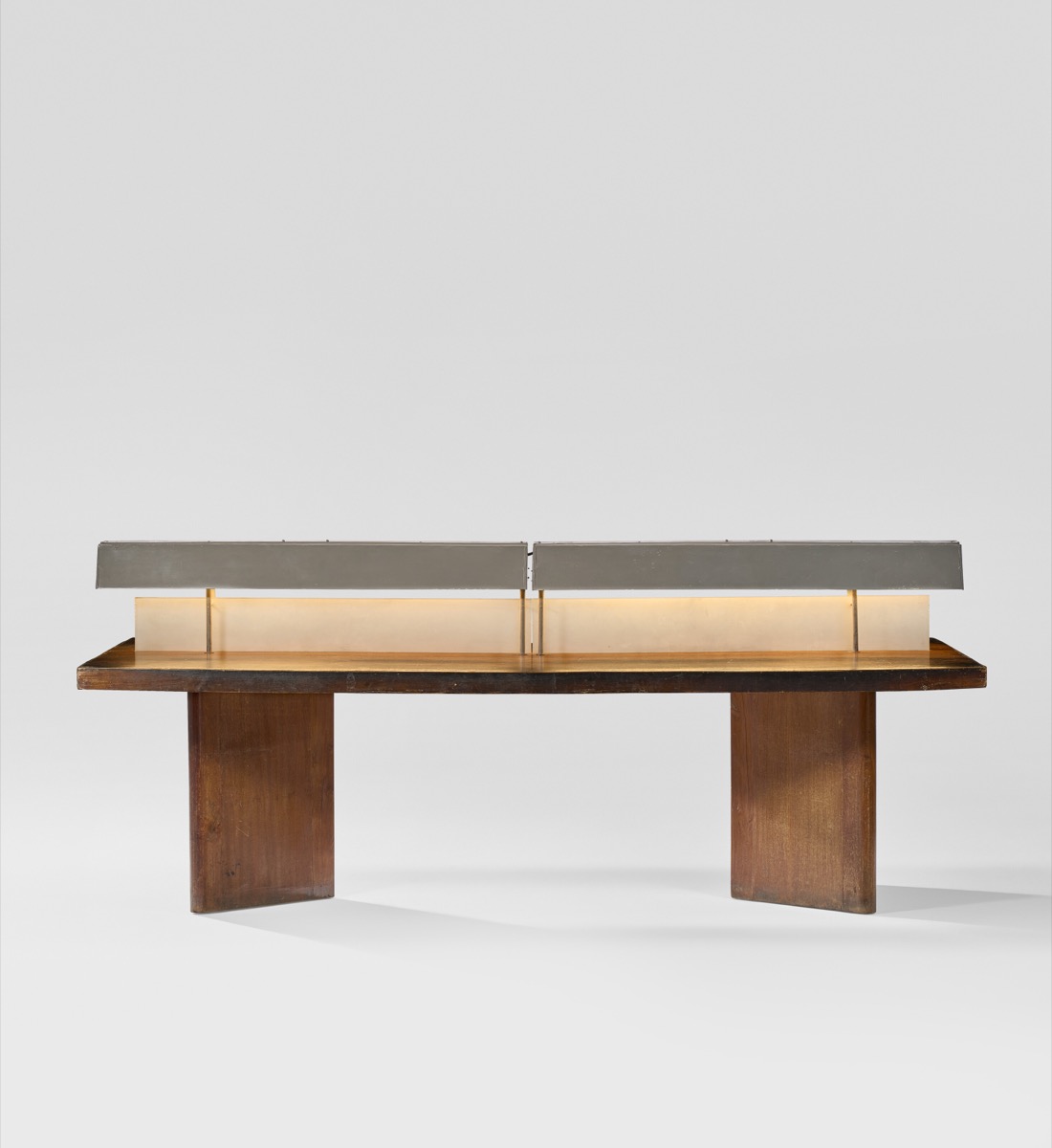
Chandigarh furniture usually trades in the tens of thousands — chairs and desks made by the hundreds for Le Corbusier and Jeanneret’s planned city. The illuminated library table is the other end of that market: a rare, architectural fixture built for the city’s institutions, with far fewer survivors. At $355,600 it set the quarter’s design ceiling and outran the typical Jeanneret lot by more than thirtyfold — proof that within “production” furniture, scarcity of the specific model is everything.
The strongest demand read we measured
Design is a $5.9M market next to art’s half-billion — and it out-demanded everything. The median lot hammered 48% over its estimate midpoint, 69% cleared their high estimate outright — the best of any vertical this quarter — and 88% of offered lots sold. Every other market we track was pickier at the hammer. When a small market runs this hot, it’s usually supply-starved demand: the good material is scarce, it comes up rarely, and the bidders who want it know they may not see another this good for a year. That is exactly the texture of the postwar design market — a handful of makers, a finite number of documented, provenanced pieces, and a bench of collectors who chase condition.
It bears repeating what this number is and isn’t: a demand signal, not a measured return. The cohorts here are thin — 170 sold lots across four makers this quarter — so our engine won’t publish a designer-level price index; none clears the confidence bar. We read the heat off the estimates instead. A lot hammering 48% over its own midpoint tells you the room wanted it more than the specialist who set the estimate expected; it does not tell you the same chair is worth 48% more than it was a year ago. On design we speak in demand and in the top of the table, and we stop there.
The ceiling: scarcity of the specific model
The two headline results — the Jeanneret illuminated library table at $355,600 and Nakashima’s Frenchman’s Cove II dining table at $330,200 — both came out of Christie’s June 10 design sale, and both make the same point. The Nakashima carried a $40–60K estimate and brought more than five times its high; the Jeanneret table, estimated $150–250K, ran past both. These aren’t records — Nakashima’s all-time high is the $822K “Arlyn” table from 2006, Jeanneret’s a $4.1M Le Corbusier canvas — but they sit far above the typical lot for each maker, and that gap is the whole thesis of the vertical: within “production” furniture built by the hundreds, the scarce, documented, architectural example is a different asset entirely from the commodity chair.
House dynamics: no single room owned it
The value was unusually spread for so small a market. Sotheby’s took the largest single share at 45%, led by a run of Prouvé — the $294K sideboard and two “Visiteur” armchairs at $230K and $166K. Wright took ~25% as the workhorse of the Nakashima and Chandigarh middle, including a $154K special-order Conoid table and a $102K sliding-door cabinet. Christie’s took ~23% but owned the two biggest lots. Where a trophy quarter in art or watches concentrates in one house, design stayed a three-room market — a sign the depth of demand is broad, not a single-sale artifact.
The maker reads: Nakashima and Prouvé grind, the commodity end drags
The durable signal is Nakashima’s +20% demand read across 65 sales — the deepest volume in the vertical, still hammering well over estimate, and the maker most likely to reward a patient bidder. Prouvé’s +14% on 36 sales echoes it, and the three makers split the tracked money almost in thirds: Nakashima 38%, Prouvé 34%, Jeanneret 26%. Where the reads soften — Eames and Jeanneret both around −11% — it’s a mix story, not a demand collapse. Eames is mostly Herman Miller production furniture with a typical tracked lot near $1,250; when the median is a mass-made lounge chair, it drags even as the rare early example holds. Jeanneret is the sharper version of the same tension: 51 sales, an 83% sell-through (the weakest in the vertical), the commodity Chandigarh chairs pulling the median down while the illuminated library table sets the quarter’s ceiling. One maker, two markets — and the median can only see one of them.
The top of the market
| Lot | House | Realized |
|---|---|---|
| Pierre Jeanneret — Illuminated Library Table, PJ-TAT-10-B | Christie's | $356K |
| George Nakashima — 'Frenchman's Cove II' Dining Table, 1968 | Christie's | $330K |
| Jean Prouvé — sideboard | Sotheby's | $294K |
| Jean Prouvé — "Visiteur" armchair | Sotheby's | $230K |
| Jean Prouvé — "Visiteur" armchair | Sotheby's | $166K |
| Charlotte Perriand — 'Tunisie' bookcase (La Maison de la Tunisie) | Christie's | $165K |
| Pierre Jeanneret — three-piece "easy" seating suite | Sotheby's | $154K |
| George Nakashima — special-order Conoid dining table | Wright | $154K |
| Jean Prouvé — Cabinet, model no. 150 | Phillips | $143K |
| George Nakashima — special-order Triple Sliding Door cabinet | Wright | $102K |
Movers
| Maker | Median vs Q2 2025 | Sales |
|---|---|---|
| George Nakashima | +20% | 65 |
| Jean Prouvé | +14% | 36 |
| Charles & Ray Eames | −11% | 18 |
| Pierre Jeanneret | −11% | 51 |
Figures cover the design sales lectr tracked in Q2 2026 (April–June) — our coverage, not the entire market. Prices are premium-inclusive as published by the houses; “vs estimate” reads are taken at the hammer, since estimates are set on hammer. Small samples are flagged where they occur. Design is thin enough that our engine abstains on designer-level appreciation — none of these cohorts clear the confidence bar. The moves shown are demand reads: how each maker's median lot is hammering against its own estimate right now, not a measured return.