
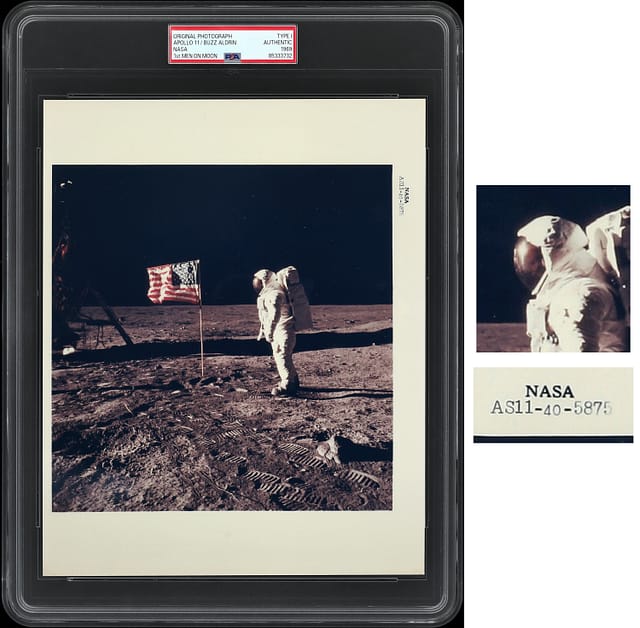
July 20, 1969: Neil Armstrong points the Hasselblad at Buzz Aldrin and takes the most famous portrait ever made off-planet — visor reflecting the photographer, the LM, and most of human ambition. This Type I print (made from the original film within about a year of the mission) led science’s quiet quarter for space material at $18,910. Nearly every image of the first landing shows Aldrin, for a reason collectors love: Armstrong held the camera. Goldin’s April sale ran a whole run of these first-generation prints — the companion NASA Type I of the landing itself brought $15,860, and a 1972 “Blue Marble” Type I $4,270 — a rare stretch of genuinely space-historical material in a quarter otherwise thin on it.
Between the seasons
Science doesn’t trade continuously the way watches do — it moves in curated seasonal sales, and the biggest ones didn’t land inside Q2. What cleared was the steady middle of the instrument market: a pair of George IV library globes at $38,400, a set of George I table globes just behind, an Austrian Biedermeier globustisch, and a Dudley Adams terrestrial globe — alongside the vintage NASA photographs that lead the space category any quarter they appear. It is a globe-heavy list, which is exactly what a between-the-seasons instrument quarter looks like: no headline meteorite, no dinosaur, just the reliable cartographic middle of the market doing its quiet business.
First, we cleaned the tape
Before any of those reads are worth anything, the tape has to be honest — and the raw Q2 science tape was not. Upstream routing had mis-filed a run of paintings and design lots under the science collections on the strength of a single word in the title: a David Hockney at $482,600 and a Thomas Houseago “Astronaut” sculpture at $123,825 landed under space; an Oscar Niemeyer bed and a Mattia Bonetti dining table under scientific instruments — because “lunar,” “celestial” and “astronaut” are as common in art titles as in a NASA caption. Left in, they’d have put a half-million-dollar painting at the top of the science tape and quietly corrupted every demand read below it. We pulled them. The eight lots above are the cleaned set: globes, a sextant, and first-generation Apollo photographs — objects that are actually scientific. We would rather show a $38,400 globe as our top lot and mean it than a $482,600 Hockney we don’t.
What demand says, since price can’t
These are collectible buckets, not priced cohorts — our engine won’t publish an appreciation figure here, so we read demand off the estimates, which science actually has (near-complete estimate coverage across these collections is what lets us). And demand is split: space at +24% and fossils at +23% over estimate are the two hottest reads in the vertical, scientific instruments roughly at estimate (+2%), and meteorites soft at −32% — the clearest cooling signal science carries right now. Read the sub-market table as “how far over (or under) the auctioneer’s number lots are settling,” not as a year-on-year price change: the “Sales” column there is each collection’s full tracked depth, from a 7,400-lot instrument market down to a thin 204-lot meteorite tape whose softness is real but sits on a small base.
The space photographs, up close
The one genuinely space-historical corner Q2 offered was Goldin’s April run of Apollo Type I photographs. A Type I is a first-generation print struck from the original flight film within roughly a year of the mission — the closest a collector gets to the negative, and the reason these clear where later reprints don’t. The Armstrong-shot Aldrin portrait led at $18,910, the NASA landing print followed at $15,860, and the 1972 “Blue Marble” — the whole-earth frame from Apollo 17, one of the most reproduced photographs in history — brought $4,270. Modest absolute numbers, but they are the real thing, and in a quarter this thin on space material they carried the collection on their own.
Where the records actually sit
None of Q2’s clearing lots came near the category ceilings, which is the point: this is a records-driven vertical between its records. The standing highs — a $37.1M scientific instrument, a $15.9M space lot, and a fossil record a July sale has since pushed past $50M (a Tyrannosaurus at Sotheby’s on July 14) — are what the seasonal sales chase, and they dwarf anything Q2 produced by three orders of magnitude. A caveat we’ll keep flagging: the two highest all-time “science” marks still carry the fingerprints of the same routing problem we cleaned out of Q2 — the instrument record is titled to a Basquiat, the space record to a Turcato canvas — which is precisely why the cleaned tape, not the raw ceiling, is the number we trust. The next note in this series, written off one of the real summer sales, will have something grounded to say about fossil and meteorite price levels.
The top of the market
Figures cover the science sales lectr tracked in Q2 2026 (April–June) — our coverage, not the entire market. Prices are premium-inclusive as published by the houses; “vs estimate” reads are taken at the hammer, since estimates are set on hammer. Small samples are flagged where they occur. A note on hygiene: the raw Q2 science tape carries a run of paintings and design lots that upstream routing mis-filed under scientific instruments and space (works with 'lunar,' 'celestial' or 'astronaut' in the title — a Hockney, a Houseago astronaut sculpture, a Niemeyer bed all surfaced above the real instruments). The top sales above are the cleaned, genuinely scientific set. The demand figures are our engine's per-collection medians over estimate — space +24%, fossils +23%, instruments +2%, meteorites −32% — read against near-complete estimate coverage in this vertical.