
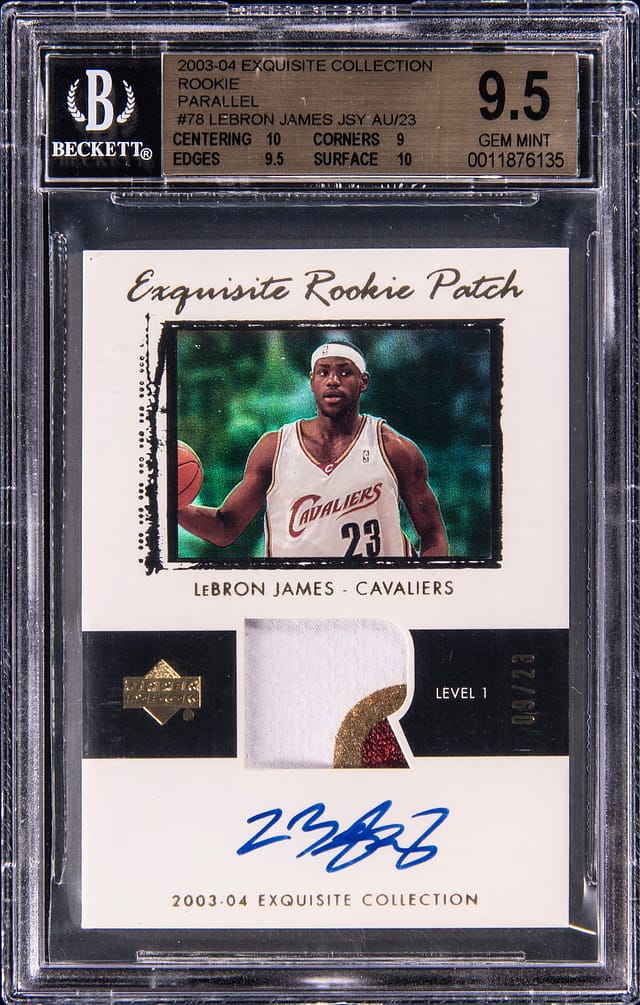
The card that defined a generation of the hobby: LeBron’s 2003-04 Upper Deck Exquisite Rookie Patch Autograph, the piece every modern RPA is measured against. It brought $2,928,000 at Goldin’s June sale — the top sports result of the quarter, edging out a $2.81M Wayne Gretzky final-Oilers jersey and a $2.56M Shohei Ohtani 1/1 SuperFractor. Three of the quarter’s four biggest lots were cards; the modern rookie market, not vintage memorabilia, set the ceiling. It is also the standing record for the entire sports-cards collection we track — the ceiling of a 290,000-lot corpus rests on a single 2003 card.
The modern cards set the ceiling
The top of the quarter was a card market, not a memorabilia one: a $2.93M LeBron rookie patch auto, a $2.56M Ohtani 1/1 SuperFractor, and a $1.83M PSA-8 ’52 Mantle — three of the four biggest lots. The lone jersey in that group, Gretzky’s photo-matched final Oilers shirt at $2.81M, is the exception that frames the rule: modern graded rookies now trade at the very top alongside the most storied vintage memorabilia.
Read the rest of the top ten and the pattern only hardens. Below the four marquee lots sits a second tier that is almost entirely cardboard: a $1.06M Shai Gilgeous-Alexander Gold Logoman and a $1.01M Panini Immaculate Logoman — both one-of-one patch autos struck from the actual jersey logo, the format the modern hobby now prizes above raw scarcity — then a $976K Pelé 1958 rookie in PSA 9 (population six), a $762.5K LeBron/Jordan/Bird triple auto, and a $622K National Treasures RPA. Nine of the quarter’s ten biggest lots were cards. The one that wasn’t, Gretzky’s jersey, is the marquee game-used piece of the year — and it still couldn’t hold the top spot.
Three currents run under those numbers. The first is the rookie patch auto — a rookie card carrying both an on-card signature and a swatch of game-worn material — which is now the blue-chip form factor across sports; the LeBron, the SGA, the Immaculate and the National Treasures lots are all RPAs. The second is the 1/1 SuperFractor, the single serial-1 parallel of a modern flagship set, where Ohtani’s 2018 Topps Chrome carried a seven-figure result on pure “only one exists” scarcity. The third is graded vintage holding its floor: the ’52 Mantle traded twice in the quarter — the PSA 8 at $1.83M and an SGC 7 at $580K — a clean, legible grade-to-price ladder that vintage still offers and raw modern cards can’t.
The marquee is still game-used
Cards set the ceiling, but the single most storied object of the quarter was worn, not printed. Gretzky’s final Edmonton Oilers jersey — Game 4 of the 1988 Stanley Cup Final, photo- matched — brought $2.81M, and the $1.34M Kobe/LeBron/Curry/Dončić game-used group put a second seven-figure worn lot in the top five. That is the shape of the game-used collection: a smaller, thicker market than cards, with a $1,280 typical lot against a standing record of $10.09M (Jordan’s 1998 “Last Dance” Finals jersey). Photo-matching — forensically tying a specific garment to a specific frame of a specific game — is what separates a $1,280 jersey from a $2.8M one, and it is the discipline the top of this collection now runs on.
The sub-markets, read descriptively
Because sports clears on bid with no estimates, we don’t report each collection as a percentage over some catalogue number — there isn’t one. We report what it is: typical price, standing record, and depth. Sports cards are the engine — a $338 typical lot, but the deepest tape we track at roughly 290,000 lots all-time, and the collection that holds the quarter’s ceiling. Game-used is the marquee — $1,280 typical, a $10.09M record. Tickets & passes ($360 typical, record $1.2M on the Brady 2000 Contenders Championship Ticket) and trophies & awards ($337 typical, a $3.54M record) are the specialist corners. And sports memorabilia — the catch-all of autographs, photos, equipment and pennants — is the retail floor at a $256 typical lot. None of these carries an appreciation figure, and we won’t invent one.
A retail-depth tape, almost all through one house
Sports is the highest-volume market we cover — 19,296 lots against a $551 median — and Goldin ran roughly 96% of the value. That single-house concentration is the market’s defining structural fact: unlike art or watches, where value is spread across Christie’s, Sotheby’s and a dozen specialists, sports flows through one weekly-auction platform that has become the price-discovery venue for the entire hobby. The mix — a handful of seven-figure cards and jerseys over a very long tail of sub-$1,000 lots — is what the vertical is: broad retail participation punctuated by a few whales. It’s also why the median stays at $551 even in a $126M quarter, and why one platform’s calendar effectively sets the tape.
Reading it without estimates
These are bid auctions — no house estimates exist, so our usual hammer-vs-estimate read doesn’t apply, and we don’t manufacture an appreciation number the data can’t support. Instead lectr prices each live lot off its own realized comps (sport-, player- and grade-matched), which is why this vertical’s “lectr value” bands matter more here than anywhere else: with no estimate in the catalogue, they’re the only estimate in the room. On a $126M quarter carried by one house, an independent, comps-driven read is not a nicety — it’s the check.
The top of the market
Figures cover the sports sales lectr tracked in Q2 2026 (April–June) — our coverage, not the entire market. Prices are premium-inclusive as published by the houses; “vs estimate” reads are taken at the hammer, since estimates are set on hammer. Small samples are flagged where they occur. Sports runs on bid auctions with no published estimates, so there is no vs-estimate read here and our engine treats the card, game-used, ticket, trophy and memorabilia buckets as descriptive — we report volume, records and top sales, not an appreciation figure. The typical (median) lot prices cited per collection are the honest read where no estimate exists to hammer against. Prices are final bid plus premium.