
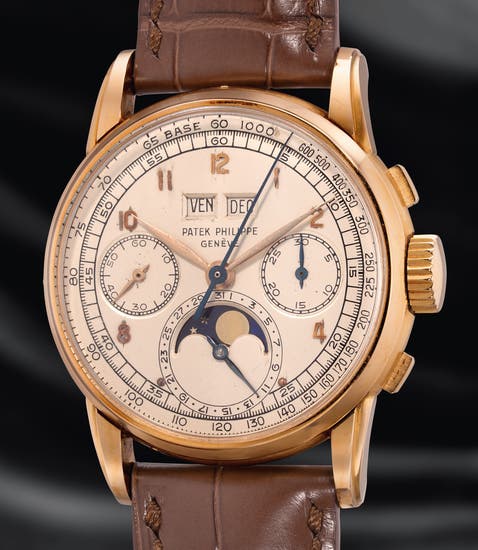
The quarter’s top watch, and one of the largest of the year: an historically important pink gold perpetual calendar chronograph with French calendar and moon phases, its case made by Vichet — the only known pink gold first-series example carrying British hallmarks. It brought $10,287,360 at Phillips’ May sale against a $3.1–6.1M estimate. Phillips owned the top of the quarter: it took 43% of all watch value and every one of the five biggest results, all of them Patek. That’s the pattern beneath a reference market that mostly refuses to resolve at all — the trophy tier keeps setting records even where the index underneath it declines to call a direction.
The only tape we’ll put a number on
Watches were the easiest market to sell into all quarter — 97–98% sell-through across 1,811 lots, with the median hammering 35% over its estimate midpoint and 55% clearing the high outright. Nothing else we track comes close on clearance or on sample depth: art buys in a third of what it offers, design ran 170 sold lots all quarter, and watches cleared better than ten times that with almost nothing left in the room. That depth is the whole reason watches is the only vertical where our engine will publish a like-for-like return. Elsewhere we speak in demand — how the median lot hammered against its own estimate — because the cohorts are too thin or too mixed to isolate a price move. Here the cohorts are big enough that a move survives its own confidence interval, so we can speak in price.
What a confidence interval means here
The engine runs a hedonic index per maker: a regression that holds reference, metal, size and condition-language constant and reads the residual as the market’s move over time — then it reports the 95% confidence interval around that move. The rule is simple: if the interval spans zero, we publish nothing. A read of “+8%, but anywhere from −5% to +21%” isn’t a direction, it’s noise wearing a number, and we’d rather say so than launder it into a headline. That is why a maker can appear at one horizon and vanish at another: the same cohort resolves cleanly over one window and dissolves into uncertainty over the next. It is also why watches is the one place we quote a return at all — everywhere else the intervals never tighten enough to clear the bar.
What the index actually says
One thing to be clear about before the numbers: the quarter above is fixed history, but the index is not. It refits nightly over the whole corpus, and the reads below are pulled out of market.json when this page is built — so they are the current state of the engine, not a Q2 snapshot. As of the Sep 12, 2026 corpus:
three watch makers clear the bar, and they don’t point the same way. Cartier is up 53.7% over five years (95% CI +21.1% to +95.1%), on a 5,772-lot cohort; Rolex is up 25.0% over five years (95% CI +12.4% to +39.0%), on a 15,235-lot cohort; Patek Philippe is down 14.3% over three years (95% CI −22.1% to −5.6%), on a 15,522-lot cohort. Every other horizon these makers hold either spans zero or fails an upstream gate, and we publish nothing there.
The rest stay descriptive. Omega reads −12.0% against its own estimates over the trailing year — a demand figure, not a price move — and its index resolves at no horizon. We report the moves that resolve and hold the ones that don’t.
Read together, that is a bifurcated market. Patek Philippe is giving ground on the index while Cartier and Rolex are compounding — exactly the kind of divergence the index exists to surface: the record-setter and the appreciating asset are not the same maker.
Trophies detached from the reference market
The top of the quarter is nearly all Patek and nearly all Phillips. The $10.3M perpetual calendar chronograph led, followed by a $9.2M cloisonné world-time and three more seven-figure Pateks — and Phillips took 43% of all tracked watch value and the five biggest results outright. Sotheby’s (28%) and Christie’s (26%) split most of the rest. Patek alone was 60% of tracked value, Rolex 16%, Cartier 15%. None of these approached a record — Patek’s all-time high is the $31.2M Grandmaster Chime from 2019 — but they didn’t need to: they are the tell that condition-and-rarity trophies keep clearing at full price whatever the deep reference tape beneath them is doing. Two of the quarter’s most interesting results were Cartiers — a Crash at $2.0M and an asymmetric gold wristwatch at $1.8M — which is the trophy tape agreeing with the index for once: a maker the engine currently reads as appreciating is also one of the houses throwing surprises at the top.
Where the opportunity sits
For a buyer, the shape of this market is the opportunity. Liquidity is total — you can sell almost anything — but outside the unrepeatable pieces the comps have already done the repricing and many estimates haven’t caught up, particularly in the Patek Philippe references the index currently reads as declining. The below-market flags our engine carries into Q3 sit in exactly that middle: not the trophies, which clear at or above every estimate, but the deep, liquid reference tape where the comps have moved and the catalogues have not. That is the one vertical where we can point at a number and defend it — so it’s the one where we do.
The top of the market
Figures cover the watch sales lectr tracked in Q2 2026 (April–June) — our coverage, not the entire market. Prices are premium-inclusive as published by the houses; “vs estimate” reads are taken at the hammer, since estimates are set on hammer. Small samples are flagged where they occur. The index reads in this note are hedonic reads of the corpus as of Sep 12, 2026, each shown with its 95% confidence interval and the horizon over which it resolves; they are re-read from market.json every time this page is built, so they are current rather than a Q2 snapshot. Where a maker's interval doesn't resolve the sign we publish no direction — Rolex at one year, Patek Philippe at one and five years, and Cartier at one and three years. Audemars Piguet and Omega clear no horizon at all. Watches is the one vertical where any maker currently clears the bar.