
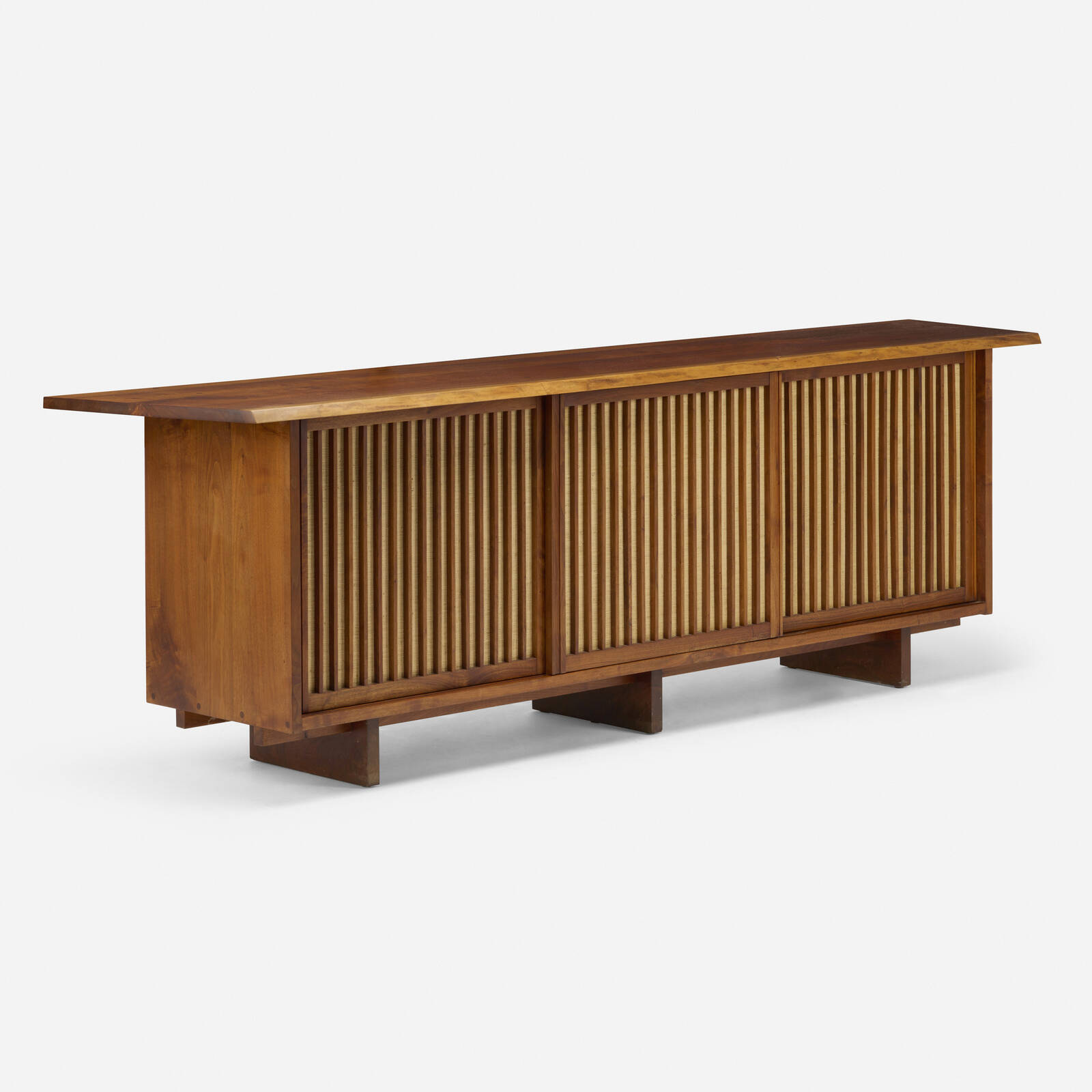
Nakashima built his reputation on the slab — the free-edged board left as the tree gave it — but the case pieces are where the joinery shows. This one is the canonical form: a long walnut carcass under a live-edge top that overhangs the ends, three sliding doors of fine vertical slats over a woven backing, the whole thing lifted on plank feet. It is a design the New Hope workshop made repeatedly, which is exactly why the result is informative: against a $40–50K estimate it sold for $96,000, nearly double the high, and set the quarter’s design ceiling. When a repeatable model clears its estimate by that much, the premium is going to the particular board on top — the figure, the edge, the width — not to rarity of the form.
A summer quarter, and a hotter one
Design’s third quarter is structurally small. The major houses hold their big design sales in late spring and in December, so July through September belongs largely to Wright: Wright took 99.7% of the $1.58M we tracked, with a pair of Bonhams lots making up the rest. Judged against itself — Q3 2025, run the same way — it was a better quarter. Value rose about 6% on slightly fewer lots (125 sold against 136), and demand quality improved on every measure: the median lot sold at 1.37× its estimate midpoint against 1.20× a year ago, 70% beat the high estimate against 55%, and only 6% sold under the low, down from 13%. Sell-through slipped from 96% to 91% — twelve lots bought in against six — which is the one soft number in an otherwise firmer quarter.
Two caveats keep this honest. First, set beside Q2’s $5.9M and 1.54× read, Q3 is a summer lull, not a turn — the spring quarter carries the Christie’s, Sotheby’s and Phillips design sales, and summer doesn’t. Second, these are demand reads, not returns. With 125 sold lots across four makers, our engine won’t publish a designer-level price index; nothing clears the confidence bar. A lot selling 37% over its own midpoint says the room wanted it more than the specialist expected — not that the same cabinet is worth 37% more than last year. The median sale price actually fell, from $6,368 to $5,376, because the mix tilted toward Eames production pieces; that’s composition, not a decline.
One sale, one maker
The quarter came down to Wright’s September 16 Modern Design sale: 40 tracked lots, $1.03M — about two-thirds of everything we recorded in Q3 — and 36 of those lots, $1.01M of the value, were Nakashima. The same sale did the same job last September ($994K on 47 lots), so this isn’t an anomaly; it is the shape of the summer design market. Nakashima took 83% of the quarter’s value and every one of the ten biggest results. The core of it was a run of Conoid furniture — the line named for the concrete-shell studio Nakashima built in New Hope — with a dining table, desk, set of six chairs and a bench bringing a combined $281,440 on the day.
What changed from a year ago is depth rather than ceiling. Last Q3’s top lot, a Conoid bench at $104,775, outsold anything this quarter. But the band beneath it filled in: 22 lots cleared $25,000 this quarter against 14 in Q3 2025, worth $913K against $661K. The sharpest single read came in August, when a Conoid Cross-Legged occasional table estimated at $15–20K sold for $57,600 — nearly three times its high. The counterweight sat in the same September room: the Minguren II dining table, the quarter’s one big Nakashima to miss, sold at $38,400 under its $40K low.
The maker reads: Nakashima cools from very hot, Eames and Jeanneret firm
Nakashima’s demand read is +51% across 52 sales, with 85% of lots over the high estimate and only one bought in. That is still the strongest deep read in design, and the median Nakashima lot rose 14% on the year, from $19,685 to $22,400 — though it is a mix median, not an index. It is also down from +64% in Q3 2025: estimates appear to be catching up with the room. Hot, but less euphoric — which is a healthier place for a market to sit.
The other two reads firmed. Eames at +17% on 59 sales (from +11%) is the volume end of the vertical — mostly Herman Miller production seating, a median lot of $1,536, and the most bought-in lots of any maker at eight, for an 88% sell-through. Jeanneret at +37% is up from +17%, but on just 13 sales against 25 a year ago, its tracked value roughly halved to $117K and its sell-through was the weakest in the vertical at 81%. Fewer Chandigarh pieces came up, and the ones that did sold well; call it a modest sample, not a trend. Prouvé had a single sale and doesn’t get a read.
The top of the market
Movers
| Maker | Demand vs estimate | Sales |
|---|---|---|
| George Nakashima | +51% | 52 |
| Pierre Jeanneret | +37% | 13 |
| Charles & Ray Eames | +17% | 59 |
Figures cover the design sales lectr tracked in Q3 2026 (July–September) — our coverage, not the entire market. Prices are premium-inclusive as published by the houses; “vs estimate” reads compare that published sold price to the estimate midpoint, so at most houses they include the buyer’s premium. Small samples are flagged where they occur. Design is thin enough that our engine abstains on designer-level appreciation — none of these cohorts clears the confidence bar. The figures in Movers are demand reads: how far each maker's median lot sold over its own estimate midpoint this quarter, not a measured return. No tracked maker's median sold under estimate, so there are no coolers to show.