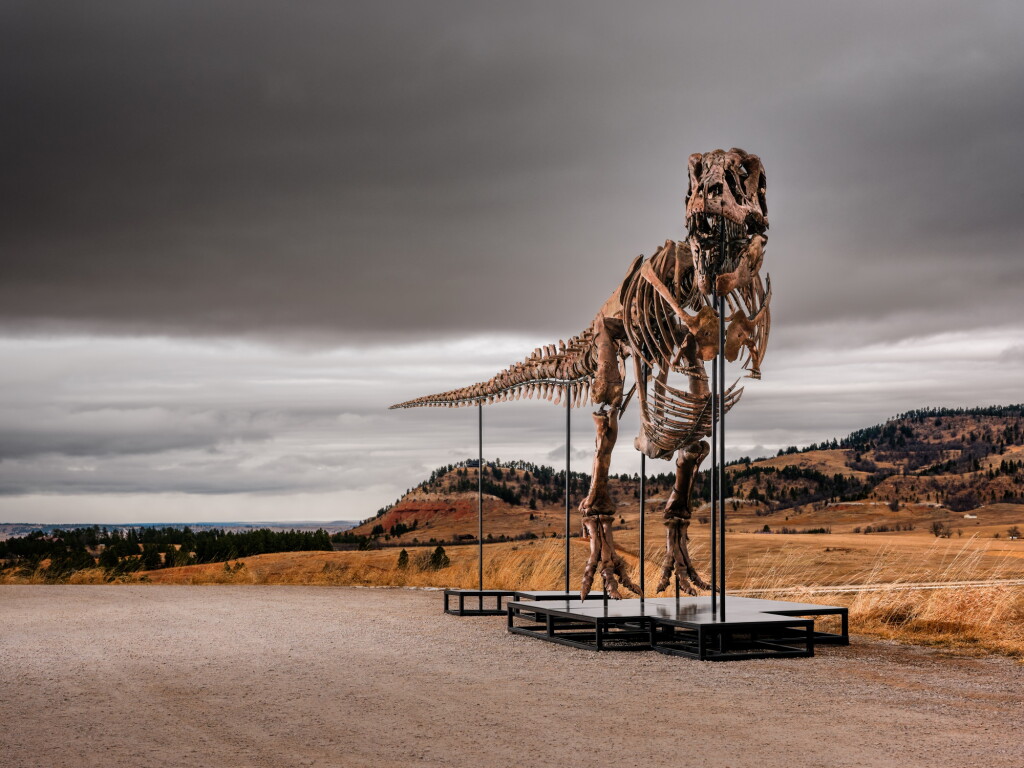
Found in 2021 on a ranch in Harding County, South Dakota, Gus is a single specimen: about 38 feet long, 12½ feet tall, 183 bone elements plus 30 of the 32 belly ribs, with roughly 82% of the skull present. Sotheby’s estimated him at $20–30 million and he sold for $50.13 million — about double the estimate midpoint, and the highest price yet paid for a dinosaur at auction. That one lot is 80% of every dollar in our Q3 science tape. It is the story of the quarter, and it is also a problem for reading the quarter, so the sections below show the market twice: with him, and with him taken out.
One skeleton was the quarter
Q2’s note said the big science sales land in the summer. They did. Sotheby’s held Natural History on July 14, Space Exploration on July 15 and History of Science & Technology the same day, and RR Auction ran a 122-lot Apple 50th-anniversary sale on August 20. Together the tape came to $62.6 million across 423 sold lots. Of that, $50.13 million is one lot: Gus. The rest of the Natural History sale added $7.3 million, which means the July 14 room accounted for $57.5 million, or about 92% of the quarter. There was one big night in science this quarter, and nearly all the money came from a single bid within it.
The quarter without him
Take Gus out and science cleared $12.5 million. The median lot hardly moves: $3,296 without him against $3,336 with him, because the median is set by the hundreds of signed NASA photographs, Edison letters and sealed iPhones that make up the body of the tape, not by its peak. The demand read doesn’t move either. Across the 366 sold lots with an estimate, the median sold at about 1.46 times its estimate midpoint with or without the T. rex, and 72% finished above the high estimate. The rest of the fossil room was strong in its own right: a T. rex leg at $1.79 million, Allosaurus jaws at $1.54 million, a Gryposaurus at $1.28 million, and decorative pieces that ran past their estimates, such as fossil sea lilies at $640,000 on a $30,000–50,000 estimate and a megalodon tooth at $48,640 on $3,000–5,000. It was not all clean, though. A baby dinosaur nest estimated at $800,000–1.2 million went unsold, as did a T. rex claw and a Camarasaurus jaw. Six of the 41 fossil lots offered did not sell.
What demand says, since price can’t
These collections are buckets of different objects, not repeat sales of the same thing, so our engine won’t publish an appreciation figure for them, and we don’t either. What we can read is where lots settled against the auctioneer’s number. Fossils at +79% over estimate (35 lots, all at Sotheby’s) is the hottest read in the vertical. Space ran +50% across 126 lots, and the like-for-like version is sharper: Sotheby’s space lots, nearly all from its July space sale, settled a median+78% over estimate this year against +4% last July, on almost the same number of sold lots (74 against 76). Scientific instruments read +83%, but on 11 lots, so treat that as a small sample. Meteorites are the soft spot at −15%. Only 8 of 34 sold lots beat the high estimate, 15 settled below the low, and 14 of the 47 meteorites offered in the Natural History sale went unsold, including a Brenham and a Gibeon each estimated at $40,000–60,000. The meteorite market has real buyers. The Seymchan centerpiece made $256,000, more than double its estimate. They are selective, though, and a sale that offers more meteorites than it has buyers for shows it.
Against last July
The headline totals don’t compare. Q3 2025 cleared $4.1 million in our coverage, but last July’s tape has no Natural History sale in it at all, so $62.6 million against $4.1 million mostly measures a sale entering coverage, not a market growing fifteen-fold. Matched sale by sale, the picture is calmer. Sotheby’s July space sale made $2.20 million against $1.81 million, and its History of Science & Technology sale made $716,000 against $660,000. RR Auction’s August Apple sale grew the most, from $454,000 to $1.69 million, but it was an anniversary sale with a deeper and better catalogue (an Apple-1, a Lisa, Jobs-signed 1976 company checks), so treat it as a bigger offering, not a hotter market. Leave out the Natural History sale and the quarter cleared about $5.1 million against $4.1 million, with the median lot at $3,336 against $1,669. On today’s corpus, the quarter before (Q2 2026) cleared $2.7 million across 546 lots with a $963 median, which is what science looks like between its seasons.
Space, up close
The top space lot was two small things with a famous job. During Apollo 11 the Engine Arm circuit breaker on the lunar module’s panel snapped off, and Buzz Aldrin pushed the breaker in with a felt-tip pen so the ascent engine could fire. That switch head and a Duro “Rocket” pen, both flown to and used on the lunar surface and sold with an Aldrin provenance letter, made $857,600 on an $800,000–1.2 million estimate. That is inside the range, not over it. The heat was further down the sale, where Aldrin-signed objects kept running away from modest estimates. A flown Soviet flag he inscribed brought $102,400 on $7,000–10,000, and a signed Tranquility Base photograph brought $64,000 on $4,000–6,000. A Skylab command-module pressure hatch brought $192,000, and the sale sold 75 of the 85 lots whose result we have.
A note on the two Apple-1s
Two Apple-1 computers sold this quarter: the “Neumark” machine in a Smith-Corona typewriter case at $499,363 (RR Auction) and another at $409,600 (Sotheby’s). It is tempting to set these against the $571,500 and $475,000 Apple-1s of Q3 2025 and draw a line, and that is exactly the appreciation claim we won’t make. These are different machines with different cases, documentation and histories, and four sales of four different objects are not a price series. What the Apple tape does show is depth: 122 lots in RR’s anniversary sale, from that Apple-1 down to sealed first-generation iPhones and a signed business card graded GEM MT 10 at $156,658. That is the science-and-technology collection at its broadest, and it’s why its +49% demand read, set against RR’s single-figure estimates, is better taken as “sold well” than as a measured premium.
The top of the market
| Lot | House | Realized |
|---|---|---|
| Tyrannosaurus rex, “Gus” — mounted skeleton, Hell Creek Formation | Sotheby's | $50.13M |
| Tyrannosaurus rex leg | Sotheby's | $1.79M |
| Allosaurus jaws with teeth — skull display | Sotheby's | $1.54M |
| Gryposaurus | Sotheby's | $1.28M |
| Apollo 11 — Duro felt-tip pen and Engine Arm circuit-breaker switch, flown to the lunar surface | Sotheby's | $858K |
| Fossil sea lilies — Jurassic display | Sotheby's | $640K |
| Apple-1 computer — the “Neumark” Apple-1 in a Smith-Corona typewriter case | RR Auction | $499K |
| Apple-1 computer | Sotheby's | $410K |
| Seymchan meteorite — monolithic centerpiece | Sotheby's | $256K |
| Fossil palm frond | Sotheby's | $218K |
Movers
| Maker | Demand vs estimate | Sales |
|---|---|---|
| Fossils & Dinosaurs | +79% | 35 |
| Space Exploration | +50% | 126 |
| Scientific Instruments | +83% | 11 |
| Meteorites | −15% | 34 |
Figures cover the science sales lectr tracked in Q3 2026 (July–September) — our coverage, not the entire market. Prices are premium-inclusive as published by the houses; “vs estimate” reads compare that published sold price to the estimate midpoint, so at most houses they include the buyer’s premium. Small samples are flagged where they occur. Movers are the median sold price over the estimate midpoint per collection, not a price change; Scientific Instruments (11 lots) is a small sample. RR Auction publishes a single estimate figure rather than a range, so its lots are read against that one number, which tends to flatter them; Goldin publishes no estimates, so its 56 lots carry no demand read. Sell-through is computed only at Sotheby's, the one house in this tape that records unsold lots (153 sold of 183 resolved, 84%); RR Auction and Goldin record only sales, and last year's Sotheby's lots were captured sold-only, so there is no like-for-like sell-through against Q3 2025. Hygiene: we removed lots routed into science by a keyword: a Horatio Nelson letter ($6,744) and an 'Untitled (Astronauts)' artwork ($1,536) this quarter, and an Arnaldo Pomodoro sculpture ($69,850) from the Q3 2025 comparison. Our engine publishes no appreciation figure for these collections, and this note makes none.