
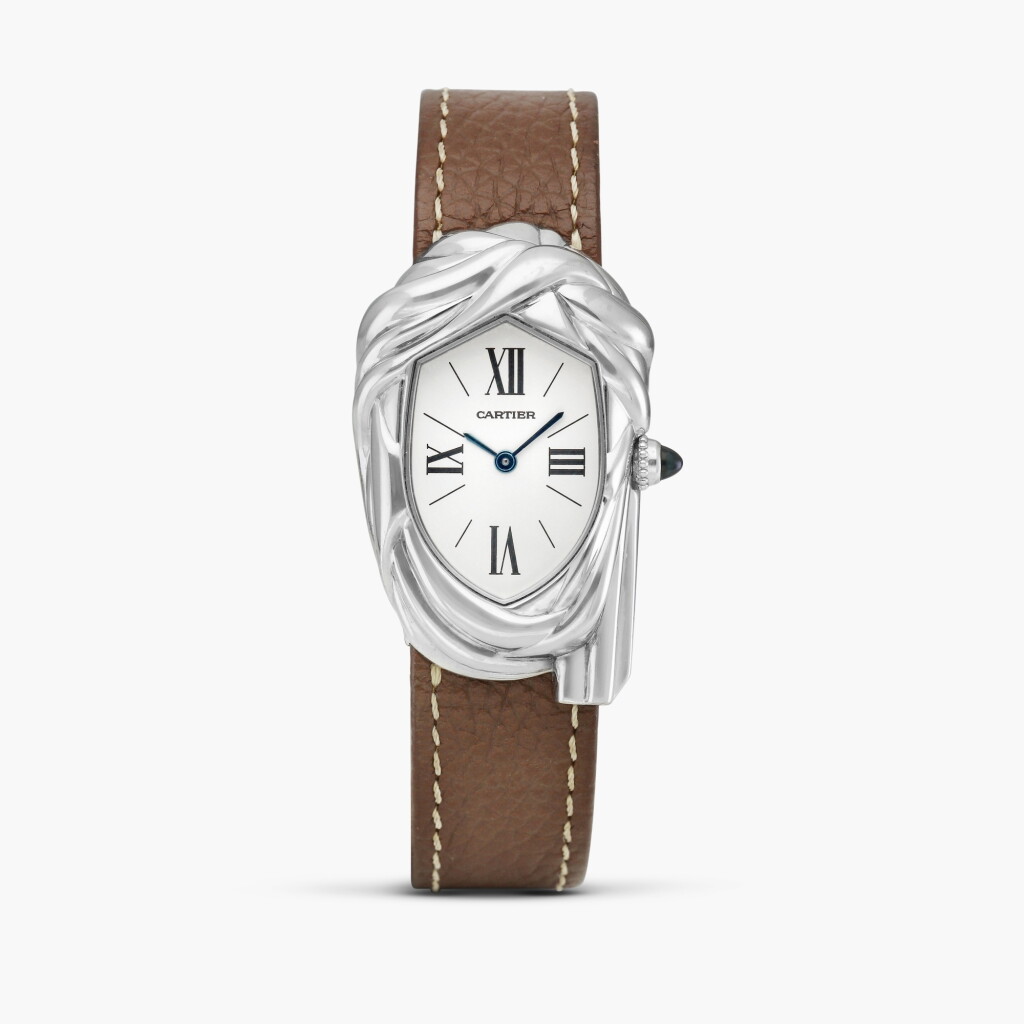
The quarter’s top watch wasn’t a Patek. The Cheich is among the most sculptural shapes Cartier ever put on a wrist: its name evokes the sheikh’s headdress, and the case is modelled on draped cloth, white gold folded around an elongated dial like a headdress framing a face, with the fold falling away past the crown. It has always been one of the rarest Cartier shapes, and Sotheby’s catalogued this example as unique. It brought $3,394,560 (about HK$26.5M) in Hong Kong on September 18 against a deliberately wide HK$8–40M estimate — more than twice the next-best watch of the quarter, and 8% of all the watch value we tracked from July to September. For scale: the biggest watch in our Q3 2025 coverage made $393K, and that quarter produced no seven-figure result at all. This one is also the clearest single expression of the quarter’s real story, which is that the collector-shape Cartiers — Cheich, Crash, Pebble — are being bid like grand complications.
The off-season, with one exception
Summer is the trough of the watch calendar — the big Geneva, Hong Kong and New York sales land in spring and autumn — so Q3 is never going to look like Q2, which on today’s corpus ran 1,784 sold lots and $245M. The honest comparison is the same quarter a year ago, and against that Q3 2026 was a different animal: 586 lots sold for $41.1M, against 331 for $10.1M in Q3 2025. Sell-through rose from 90.9% to 95.1%, the median sale from $15,443 to $22,938, and the median lot sold at 1.27× its estimate midpoint (1.18× a year ago), with half the room clearing the high outright. Only 3.8% sold under the low estimate. On every measure the quarter was deeper and hotter than its predecessor — but most of the dollar gain has a single address.
Strip out one sale and the dollars are flat
Sotheby’s two-session Important Watches sale in Hong Kong on September 18–19 sold 208 lots for $30.1M — 73% of everything we tracked in the quarter, and every one of the ten biggest results. Our Q3 2025 coverage has no equivalent sale; with it, Sotheby’s took 86% of the quarter’s watch value, Phillips 12% and Bonhams 2%, and we tracked no Christie’s watch sale in either summer. Take that one weekend out and the rest of the quarter made $10.9M from 378 lots — barely above last year’s $10.1M. The recurring September dates tell the same story sale by sale: Phillips in Geneva sold 39 lots for $2.58M (34 for $2.63M a year earlier), Phillips Hong Kong 64 for $2.13M (71 for $2.40M), and Sotheby’s Hong Kong Fine Watches 152 for $2.87M (115 for $3.47M). What did change outside the trophy sale is price against estimate: the rest of the quarter sold at a median 1.28× its estimate midpoint, with 53% beating the high. Volume held; the bar got cleared by more.
Cartier carried the room — and the bought-ins
Cartier was the hottest maker we track all quarter: 118 sold at a median 42% over the estimate midpoint, double its 21% a year ago (on 70 lots), with 63% clearing the high. The Hong Kong sale is where it showed. The Cheich led; six Crash variants made $3.05M between them, topped by a possibly unique sapphire-set reference 2774 at $885K; and a mid-sized 1970s gold Pebble estimated at $122–192K sold for $492K. Fifty-five Cartiers sold in that sale at a median 1.45× estimate, 35 of them over the high. The same catalogue also produced the quarter’s one soft patch, and it was Cartier too: 26 of the 30 watches bought in all quarter were Cartiers, 22 of them in Hong Kong — mostly early jeweller’s-era ladies’ watches, pendant and purse watches, none estimated above $36K. Cartier’s sell-through was 81.9%; Patek Philippe and Audemars Piguet sold every lot they offered. The market is paying up for the collector shapes and passing on the Edwardian jewellery. (Cartier’s median sale also rose from $5,109 to $19,661, but that is composition — last summer’s Cartiers were mostly small Bonhams lots — not a price move, and we don’t read it as one.)
What a confidence interval means here
Everything above is demand: how the median lot sold against its own estimate. It is fast and mix-proof, but it is not a return. For a return the engine runs a hedonic index per maker — a regression that holds reference, metal, size and condition language constant and reads the residual as the market’s move over time — and reports the 95% confidence interval around that move. If the interval spans zero, we publish nothing. A read of “+8%, but anywhere from −5% to +21%” isn’t a direction, it’s noise wearing a number, and a summer quarter of 586 lots doesn’t change that arithmetic: the index fits the whole corpus back to the early 1990s, and one hot Hong Kong weekend moves it only as far as its weight allows.
What the index actually says
The quarter above is fixed history; the index is not. It refits nightly over the whole corpus, and the reads below are pulled out of market.json when this page is built — so they are the current state of the engine, not a Q3 snapshot. As of the Nov 8, 2026 corpus:
two watch makers clear the bar. Patek Philippe is up 208.1% since 1991 (95% CI +153.0% to +275.2%), on a 20,601-lot cohort; Rolex is up 24.9% over five years (95% CI +1.3% to +54.0%), on a 18,016-lot cohort. Every other horizon these makers hold either spans zero or fails an upstream gate, and we publish nothing there.
The rest stay descriptive. Cartier reads +16.2%; Audemars Piguet reads +0.0%; Omega reads −8.6% against estimates on the engine’s own demand line — a trailing-twelve-month median read before the buyer’s premium, so it runs well below the premium-inclusive quarter figures in this note and is not a price move. None of them resolves an index at any horizon.
Where the opportunity sits
Put the two reads side by side and the quarter inverts. The makers the room chased hardest — Cartier at 42% over estimate, Omega at 38% (on 41 lots), Audemars Piguet at 28% — are the ones the index can’t yet price, because their like-for-like cohorts are too thin or too mixed in the recent quarters to resolve. The two makers with the softest demand, Patek Philippe (20% over, on 214 lots, unchanged from 19% a year ago) and Rolex (19%, up from 13%), are the two the engine will put a number on. For a buyer that is the shape of the opportunity: the Cartier tape is running on estimate heat that no index yet underwrites, while the deep Patek and Rolex reference market clears at a modest premium to estimates on a long-run index that points up. The below-market flags our engine carries into Q4 sit in that middle — not the unrepeatable pieces, which clear at or above every estimate, but the liquid references where the comps have moved and the catalogues have not. The autumn sales will say whether the Cartier premium holds once the Patek-heavy calendar returns.
The top of the market
Movers
| Maker | Median sold vs estimate | Sales |
|---|---|---|
| Cartier | +42% | 118 |
| Omega | +38% | 41 |
| Audemars Piguet | +28% | 70 |
| Patek Philippe | +20% | 214 |
| Rolex | +19% | 143 |
Figures cover the watch sales lectr tracked in Q3 2026 (July–September) — our coverage, not the entire market. Prices are premium-inclusive as published by the houses; “vs estimate” reads compare that published sold price to the estimate midpoint, so at most houses they include the buyer’s premium. Small samples are flagged where they occur. Sell-through counts sold against bought-in lots only; 107 lots whose results the houses had not published at the time of writing are left out of both sides. The quarter-level demand figures (the Movers table, and every sold-vs-estimate figure in the prose) are medians of published sold price over the estimate midpoint; they are not returns. The index reads are hedonic reads of the corpus as of Nov 8, 2026, each shown with its 95% confidence interval and the horizon over which it resolves; they are re-read from market.json every time this page is built, so they are current rather than a Q3 snapshot. Where a maker's interval doesn't resolve the sign we publish no direction — Rolex at one year and Patek Philippe at one, three, and five years. Audemars Piguet, Omega, and Cartier clear no horizon at all.